

Cart
0
Best Face Pack for Acne-Prone Skin
Acne is one of the most frustrating, multi-factorial skin conditions in dermatology. Characterized by excess sebum (oil) production, hyperkeratinization (sticky dead cells clogging pores), bacterial proliferation (Cutibacterium acnes), and subsequent localized inflammation, breakouts rarely resolve with simple surface washing.
When searching for the best face pack for acne-prone skin, many shoppers fall into the trap of using overly harsh formulas that strip the protective skin barrier. Stripping leads to trans-epidermal water loss (TEWL), triggering the sebaceous glands to produce even more compensatory oil.
To break this cycle, an effective acne face pack must balance deep pore decongestion with biological calming agents. Below, we break down the top acne-fighting ingredients, examine the cellular biology of botanical actives, and review how to assemble an effective weekly routine.
Why Does Acne-Prone Skin Need Special Care?
Excess sebum, accumulated dead skin cells, environmental impurities and clogged pores can contribute to the appearance of pimples and blackheads. However, repeatedly using harsh scrubs or strong cleansing products may strip the skin’s natural moisture and leave it feeling irritated.
A suitable face pack should therefore do more than remove oil. It should gently cleanse congested skin, absorb excess sebum and leave the face feeling fresh without causing excessive dryness.
Benefits of Green Clay for Acne-Prone Skin
Green clay is valued in skincare for its natural oil-absorbing and deep-cleansing properties. It helps draw out surface impurities and remove excess oil that can make the skin appear greasy.
Regular use of a green clay face pack may help:
- Absorb excess oil from the skin
- Cleanse congested pores
- Reduce the appearance of unwanted shine
- Improve the look of uneven skin texture
- Leave the skin feeling clean and refreshed
Because clay can become drying when used too frequently, it is important to follow the recommended usage instructions and moisturise the skin afterwards.
Why Is Green Tea Added?
Green tea is rich in naturally occurring antioxidants and is widely used in skincare formulations for its soothing properties. It complements the cleansing action of green clay by helping the skin feel calm, comfortable and refreshed.
Together, green tea and green clay provide a balanced approach to caring for oily and blemish-prone skin. Green clay helps absorb oil and impurities, while green tea supports a fresh and soothed skin appearance.
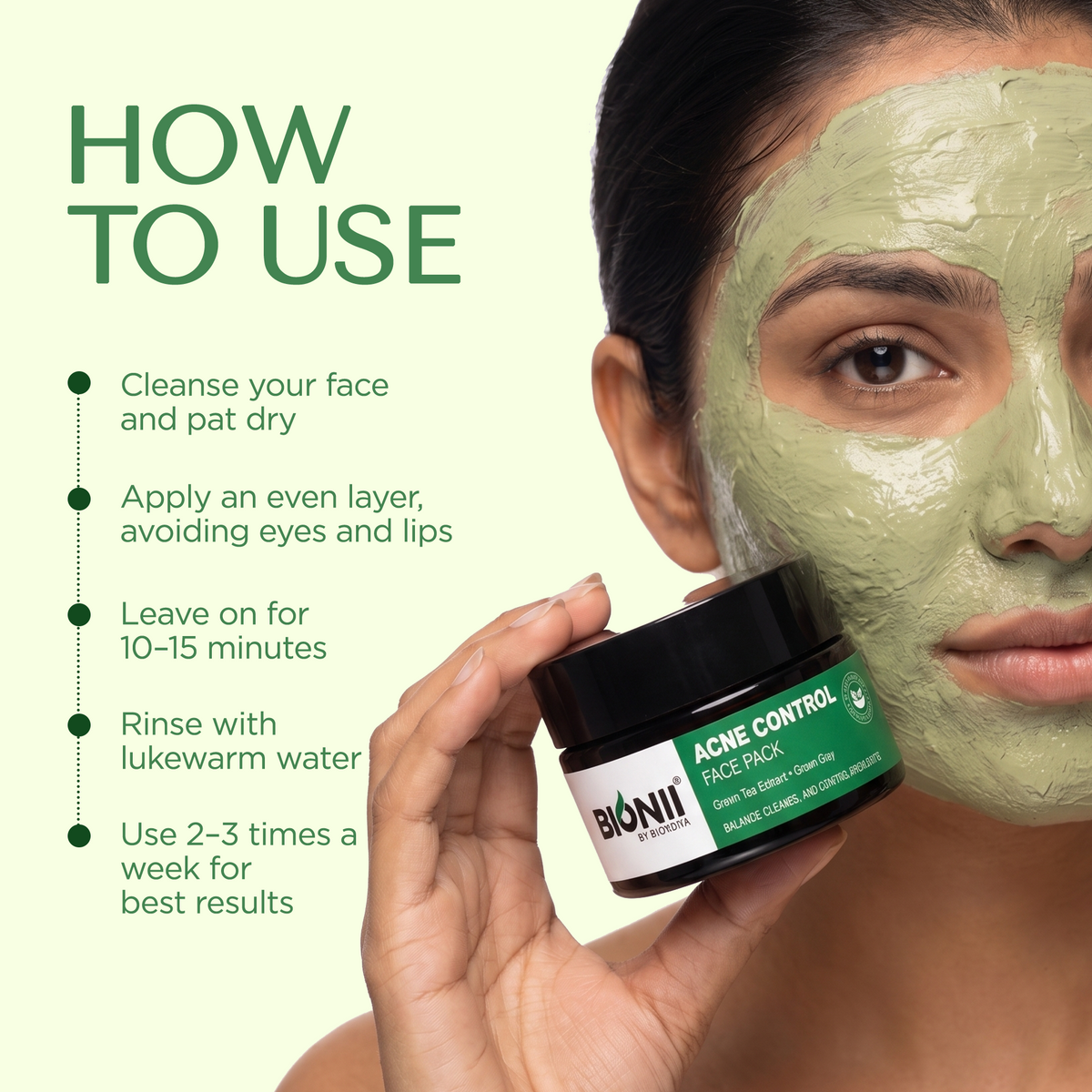
How to Use an Acne-Control Face Pack
Apply an even layer of the face pack to freshly cleansed skin, avoiding the delicate eye and lip areas. Allow it to remain on the skin for the time mentioned on the product label. Do not leave the pack on until it becomes excessively dry or uncomfortable.
Rinse thoroughly with water and pat the skin dry. Follow with a lightweight, non-comedogenic moisturiser. Depending on your skin type and the product instructions, the face pack can generally be used once or twice a week.
Always perform a patch test before using a new skincare product, particularly if your skin is sensitive.
Choosing the Best Face Pack for Acne-Prone Skin
Look for a face pack that:
- Controls excess oil without over-drying
- Contains ingredients suitable for blemish-prone skin
- Cleanses gently without harsh scrubbing particles
- Is easy to apply and rinse
- Fits comfortably into your weekly skincare routine
A green tea and green clay acne-control face pack can be a practical choice for people experiencing oily, congested or blemish-prone skin. With consistent use and a gentle skincare routine, it can help keep the skin feeling purified, balanced and visibly refreshed.
Comparing the Top Acne-Fighting Face Pack Ingredients
Different active ingredients target different stages of the acne cascade. Understanding how each ingredient functions helps determine which face pack suits your specific breakout type.
| Ingredient | Primary Action | Best Breakout Type | Potential Drawback |
| French Green Clay (Illite/Montmorillonite) | Absorbs excess sebum, draws out micro-impurities | Oily skin, blackheads, congested pores | Can cause tightness if left on to dry completely |
| Salicylic Acid (BHA) | Keratolytic (dissolves pore-clogging dead cells inside pores) | Comedones (whiteheads/blackheads), bumpy texture | Potential peeling or sensitivity if overused |
| Green Tea Extract (EGCG) | Inhibits lipogenesis, neutralizes inflammatory cytokines | Red, painful, inflammatory papules and pustules | Mild astringency; rarely irritating |
| Tea Tree Oil (Melaleuca alternifolia) | Direct antimicrobial action against C. acnes | Active, infected pustules | High risk of contact dermatitis if unbuffered |
| Neem Leaf Extract (Azadirachta indica) | Antibacterial, anti-fungal, traditional purifier | Hormonal flares, secondary surface infections |
Characteristic herbal scent; variable active potency |
1. French Green Clay (Montmorillonite & Illite)
Unlike heavy bentonite clays which can over-dry sensitive skin, French green clay features a porous mineral structure rich in decomposed plant matter, iron oxides, and magnesium. It works via ionic exchange: as it dampens, its negatively charged mineral plates attract positively charged impurities, oxidized lipids, and surface bacteria, pulling them away without disrupting intercellular lipid matrices.
2. Salicylic Acid (Beta Hydroxy Acid)
Salicylic acid is lipid-soluble, meaning it penetrates through oil straight into the pilosebaceous follicle. It breaks down the desmosomes (protein bonds) that hold dead keratinocytes together, preventing the plug (microcomedone) from forming in the first place.
3. Green Tea Extract (Camellia sinensis)
Rich in catechins, green tea tackles acne from a cellular signaling standpoint rather than merely scrubbing the surface. It pairs synergistically with clays to offset drying effects with deep antioxidant support.
4. Tea Tree & Neem Extracts
Both botanical options offer broad-spectrum antimicrobial action. While pure tea tree oil can be sensitizing, incorporating stabilized tea tree or neem extract into a clay suspension reduces bacterial colonization without causing contact dermatitis.
The Biological Mechanism: How Green Tea Polyphenols (EGCG) Halt Acne
Green tea’s primary bioactive polyphenol is Epigallocatechin-3-Gallate (EGCG). While many topical products claim antioxidant status, EGCG has documented, targeted mechanisms inside human sebocytes and immune cells:
1. Sebum Regulation via 5α-Reductase and SREBP-1c Inhibition
Sebum synthesis in human sebocytes is largely driven by androgens (testosterone and dihydrotestosterone or DHT). The enzyme 5-alpha-reductase (Type 1) converts systemic testosterone to DHT within facial sebaceous glands.
Clinical research demonstrates that EGCG acts as a natural 5-alpha-reductase inhibitor. By downregulating this enzymatic conversion, EGCG prevents the activation of Sterol Regulatory Element-Binding Protein-1c (SREBP-1c), the master transcription factor responsible for lipogenesis (oil production). In simpler terms: EGCG signals oil glands at the genetic level to downscale excessive sebum generation.
2. Deactivating the NF-κB Inflammatory Pathway
When C. acnes bacteria proliferate inside an oxygen-deprived, clogged pore, they release lipopolysaccharides and damage-associated molecular patterns. This activates Nuclear Factor Kappa B (NF-κB), an intracellular master switch that drives the release of pro-inflammatory cytokines such as Interleukin-6 (IL-6), Interleukin-8 (IL-8), and Tumor Necrosis Factor-alpha (TNF-α).
These cytokines cause the visible throbbing, redness, and swelling of cystic pimples. Topical EGCG enters the epidermis and blocks the phosphorylation of the IκB kinase complex, preventing NF-κB from migrating to the cell nucleus. The result is a direct cessation of the inflammatory cascade, reducing swelling and preventing post-inflammatory hyperpigmentation (PIH).
The Verdict: Why Green Clay + Green Tea is a Synergistic Pairing
Singular chemical exfoliants (like high-dose acids) can occasionally irritate compromised acid mantles, while purely botanical pastes often lack the oil-binding capacity needed for truly congested skin.
A formulation uniting French Green Clay with concentrated Green Tea Extract addresses both physics and biology:
-
The Clay (Physical Decongestion): Binds oxidized surface oil, loosens microcomedones, and clears the path.
-
The Green Tea (Biochemical Regulation): Calms vascular erythema, neutralizes bacterial lipid oxidation, and slows down downstream sebum excretion.
How to Apply an Acne Face Pack for Maximum Results
-
Step 1: Double Cleanse Gently. Wash away sunblock and pollution with a mild, sulfate-free cleanser. Avoid physical grain scrubs, which create micro-tears.
-
Step 2: Apply to Damp Skin. Spread an even layer (~2 mm thick) across the T-zone and affected breakout areas, avoiding the orbital bone and mucosal lips.
-
Step 3: Respect the Dry Time (The "Golden Rule"). Never let a clay mask crack or turn completely chalky-white. Once the edges begin to dry while the center remains slightly tacky (approx. 8–10 minutes), rinse it off. Allowing clay to crack leaches hydration straight from viable skin cells.
-
Step 4: Emulsify with Tepid Water. Splash with lukewarm water to soften the clay, massaging in light circular motions before wiping away with a soft washcloth.
-
Step 5: Lock in Barrier Lipids. Follow immediately with a lightweight, non-comedogenic hyaluronic acid serum and a ceramide-based gel moisturizer.
Frequently Asked Questions
What is the best type of face pack for acne-prone skin?
The best face pack combines sebum-absorbing minerals like French green clay or kaolin with anti-inflammatory botanical actives like green tea extract (EGCG) or antibacterial agents like salicylic acid and tea tree oil.
How often should I use an acne face pack?
For oily and acne-prone skin, using a face pack 1 to 2 times per week is ideal. Overusing face packs can strip the natural moisture barrier and trigger compensatory oil production.
How does green tea extract help with acne breakouts?
Green tea contains Epigallocatechin-3-Gallate (EGCG), a catechin that inhibits the 5-alpha-reductase enzyme to lower sebum output and blocks the NF-κB pathway to suppress redness and inflammation.
Is green clay better than bentonite clay for acne?
Green clay (illite/montmorillonite) is generally gentler and better mineralized for blemish-prone skin than calcium or sodium bentonite, which can excessively dehydrate sensitive or active breakout zones.
Should I let a clay face pack dry completely until it cracks?
No. When clay dries to a flaky, cracked state, it begins pulling essential water out of deeper skin layers, damaging the skin barrier. Rinse it off while it is still slightly damp and tacky to the touch.
Can a face pack cause skin purging?
If the face pack contains cellular turnover actives like Salicylic Acid (BHA) or Glycolic Acid (AHA), temporary purging may occur. Pure clay and green tea masks typically do not cause true purging.
Can I use an acne face pack on active cystic acne?
Yes, provided the pack does not contain coarse abrasive particles or scrubbing beads. Soothing formulations containing green tea and green clay help bring down swelling and redness on cystic bumps.
What should I apply after using an acne face pack?
Always follow with an alcohol-free hydrating toner or serum (such as hyaluronic acid or niacinamide) and seal with an oil-free, non-comedogenic gel moisturizer to protect your skin barrier.
Can I leave an acne face pack on overnight?
No. Clay-based or clarifying face packs should never be left on overnight because they will severely disrupt your lipid barrier. Only specifically formulated overnight hydration sleeping masks should be left on.
Does salicylic acid work better in a face pack or a leave-on serum?
Salicylic acid in a face pack provides short-contact therapy, minimizing irritation while unclogging pores. Leave-on serums provide continuous keratolytic action, which may be harsher for reactive skin types.
Can dry or combination skin types use green clay face packs?
Yes. Combination skin types can 'multi-mask' by applying the green clay pack exclusively to oily, breakout-prone areas (like the forehead, nose, and chin) while keeping the cheeks hydrated.
Can natural face packs cure acne permanently?
No single topical product permanently cures acne, as it is influenced by hormones, diet, genetics, and stress. Face packs are supportive topical management tools to control oil, bacteria, and swelling.
Can I mix essential oils like pure tea tree into my clay pack?
Do not mix pure, undiluted tea tree oil directly into DIY packs at home; it is a common cause of chemical burns and allergic contact dermatitis. Use professionally stabilized, lab-tested formulations.
Does green tea help fade acne marks (PIH)?
Yes. Because EGCG reduces the initial inflammatory burst caused by acne, it shortens the lifespan of pimples and lowers the likelihood of severe post-inflammatory hyperpigmentation (dark spots).
Should I steam my face before applying an acne face pack?
Gentle warmth from a warm shower is beneficial to loosen sebum, but intense facial steaming can dilate facial capillaries, worsen active inflammatory redness, and trigger rosacea flares.


