

Cart
0
Sunscreen Guide: Why SPF 50 Important for Everyday Skin Protection
Sunscreen is one of the most important steps in any daytime skincare routine. Whether you are concerned about tanning, uneven skin tone, pigmentation, premature ageing or long-term sun exposure, regular sunscreen use should be a daily habit.
Many people still use sunscreen only when they are going outdoors for several hours. In reality, daily exposure can happen while commuting, driving, sitting near windows or spending short periods outside.
A good sunscreen should provide reliable protection against UVA and UVB radiation, while modern formulations may also be designed to address visible light, blue light and infrared exposure.
This guide explains how sunscreen works, what SPF and PA ratings mean, how much sunscreen to use and how to choose the right sunscreen for everyday use.
What Does Sunscreen Do?
Sunscreen contains UV filters that help reduce the amount of ultraviolet radiation reaching the skin.
The two major types of ultraviolet radiation relevant to skincare are:
UVA Rays
UVA rays penetrate deeper into the skin and are associated with:
- Premature skin ageing
- Uneven skin tone
- Pigmentation
- Loss of skin elasticity
- Long-term sun-related skin damage
UVA exposure can occur even when the weather does not feel particularly sunny.
UVB Rays
UVB rays are strongly associated with:
- Sunburn
- Redness
- Direct sun-related skin damage
A good daily sunscreen should therefore provide broad-spectrum UVA and UVB protection.
What Does SPF Mean?
SPF stands for Sun Protection Factor.
It primarily indicates the level of protection a sunscreen provides against UVB radiation when used correctly.
Common sunscreen ratings include:
- SPF 15
- SPF 30
- SPF 40
- SPF 50
For everyday high-protection skincare, SPF 50 sunscreen is commonly preferred, especially for people spending time outdoors or living in regions with significant sun exposure.
However, SPF alone should not be the only factor you consider.
What Does PA+++ Mean?
The PA rating indicates the level of UVA protection offered by a sunscreen.
You may see:
- PA+
- PA++
- PA+++
- PA++++
A sunscreen labelled SPF 50 PA+++ provides high UVB protection along with strong UVA protection.
When comparing sunscreens, look at both the SPF rating and the PA rating.
Why Broad-Spectrum Sunscreen Matters
The term broad-spectrum sunscreen generally means that the formulation is designed to provide protection against both UVA and UVB radiation.
Choosing a broad-spectrum sunscreen is important because UVA and UVB rays affect the skin differently.
Using only high SPF without adequate UVA protection may not provide the complete protection consumers expect.
A practical sunscreen label should therefore clearly communicate:
Broad-Spectrum + SPF Rating + UVA Protection Rating
Is Sunscreen Needed Every Day?
For most people, sunscreen should be part of the daily morning skincare routine whenever meaningful sun exposure is expected.
This includes days when you are:
- Going to work
- Driving
- Walking outdoors
- Travelling
- Exercising outside
- Sitting near sun-facing windows
- Spending time on terraces or balconies
Consistency is more important than using sunscreen occasionally.
Daily use can also help support routines designed to manage pigmentation, acne marks and uneven skin tone, because repeated sun exposure can make visible discoloration more noticeable.
How Much Sunscreen Should You Apply?
One of the most common sunscreen mistakes is applying too little.
Sunscreens are tested at a specific application amount, and applying a very thin layer may reduce the protection actually achieved.
For the face and neck, use an adequate and even amount of sunscreen and make sure commonly missed areas are covered.
These may include:
- Ears
- Hairline
- Neck
- Jawline
- Around the nose
- Exposed upper chest
Do not rely on a tiny quantity simply because the product feels concentrated.
When Should Sunscreen Be Applied?
Sunscreen should normally be the last step of your daytime skincare routine.
A simple sequence is:
Cleanser → Serum → Moisturiser → Sunscreen
If you wear makeup:
Cleanser → Serum → Moisturiser → Sunscreen → Makeup
Give each skincare layer a little time to settle before applying the next product.
Do You Need to Reapply Sunscreen?
Yes, especially when protection may have been reduced.
Reapplication becomes particularly important after:
- Sweating heavily
- Swimming
- Towel drying
- Extended outdoor exposure
People spending long periods outside should follow the reapplication directions stated on their sunscreen.
Sunscreen for Oily and Acne-Prone Skin
People with oily or acne-prone skin sometimes avoid sunscreen because they worry it will feel greasy or clog their skin.
Instead of avoiding sunscreen, choose a formulation designed for comfortable everyday wear.
Look for properties such as:
- Lightweight texture
- Non-heavy finish
- Easy spreadability
- Comfortable daily use
- Compatibility with acne-care routines
People using active skincare ingredients such as glycolic acid or retinoids should be particularly consistent with daytime sun protection.
Sunscreen for Dry Skin
Dry skin may benefit from sunscreen formulations that work well alongside moisturising products.
Ingredients such as ceramides are commonly used in skincare to support the skin barrier.
For dry skin, a routine may include:
Gentle cleanser → Hydrating serum → Moisturiser → Sunscreen
The sunscreen should sit comfortably over the moisturiser without excessive pilling or heaviness.
What Are Organic UV Filters?
In sunscreen terminology, organic UV filters are carbon-based compounds designed to absorb ultraviolet radiation.
They are sometimes informally called "chemical filters," although the term "organic UV filter" is more technically descriptive.
Modern organic UV-filter formulations can provide effective broad-spectrum protection while allowing manufacturers to create lighter, cosmetically elegant sunscreen textures.
What Is Visible Light Protection?
Visible light is the portion of electromagnetic radiation that humans can see.
There is growing consumer interest in sunscreens designed to provide broader environmental light protection, particularly among people concerned about pigmentation and uneven skin tone.
Some advanced sunscreen formulations therefore position themselves beyond conventional UVA and UVB protection.
What About Blue Light?
Blue light is part of the visible light spectrum.
It can come from sunlight as well as artificial light sources and digital screens.
Sunlight remains a much stronger source of environmental visible light than typical screen exposure.
Consumers concerned about comprehensive environmental exposure may choose sunscreen formulations positioned for visible light and blue light protection in addition to UVA and UVB protection.
What Is Infrared or IR Protection?
Infrared radiation forms another part of the electromagnetic spectrum.
Some advanced sunscreen formulations include ingredients or technologies positioned to help support skin protection against broader environmental exposure, including infrared radiation.
When evaluating these products, consumers should still prioritise the fundamentals first:
Broad-spectrum UVA + UVB protection and adequate SPF.
Additional protection features should complement—not replace—those essentials.
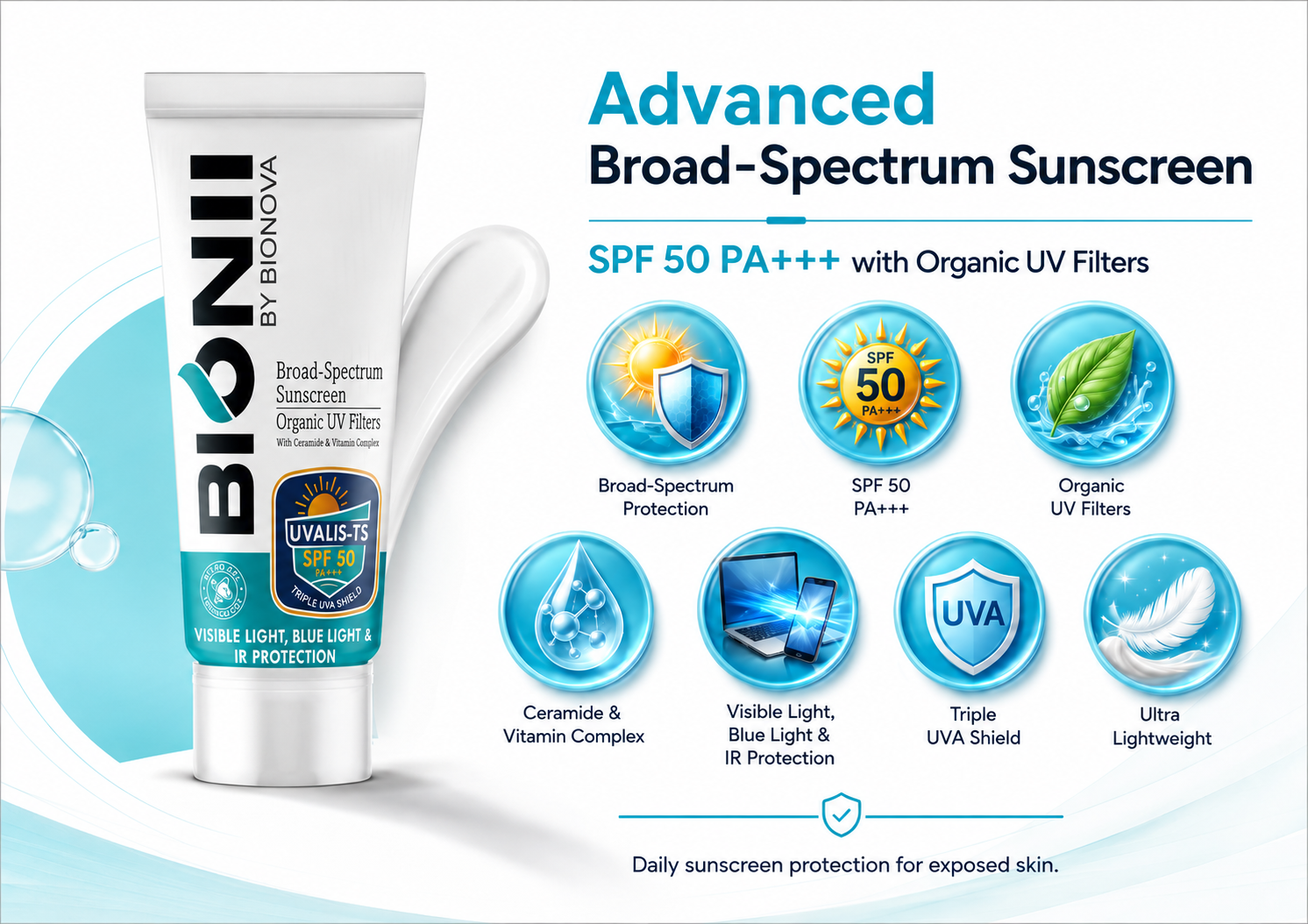
Introducing Bionii UVALIS-TS Broad-Spectrum Sunscreen SPF 50 PA+++
For people looking for an advanced everyday sunscreen, Bionii UVALIS-TS Broad-Spectrum Sunscreen SPF 50 PA+++ combines high sun protection with modern skincare-focused positioning.
Key features include:
- SPF 50
- PA+++
- Broad-Spectrum Sunscreen
- Organic UV Filters
- Ceramide & Vitamin Complex
- Triple UVA Shield
- Visible Light Protection
- Blue Light Protection
- IR Protection
- Micro-Gel Technology
UVALIS-TS is designed to fit easily into a regular morning skincare routine.
Suggested Routine
Cleanser → Serum → Moisturiser → UVALIS-TS Sunscreen
For best results, apply an adequate amount evenly to exposed skin and follow the reapplication directions on the product.
Common Sunscreen Mistakes to Avoid
1. Using Sunscreen Only in Summer
UV exposure occurs throughout the year. Sunscreen should not automatically disappear from your routine during cloudy or cooler seasons.
2. Applying Too Little
Insufficient application may reduce the protection achieved.
3. Ignoring the Neck
Many people protect their face but leave their neck exposed.
4. Depending Only on SPF
Look for broad-spectrum protection and UVA protection as well.
5. Applying Sunscreen Before Your Serum
Sunscreen should normally come after your regular skincare steps.
6. Never Reapplying Outdoors
Extended outdoor exposure may require sunscreen reapplication.
7. Assuming Makeup With SPF Is Always Enough
Cosmetics containing SPF can be useful, but they may not be applied in the quantity needed to provide the labelled level of sun protection.
How to Choose the Best Sunscreen for Your Skin
When buying sunscreen online, check:
| Feature | What to Look For |
|---|---|
| SPF | Prefer adequate daily UVB protection |
| UVA Rating | Check PA rating or equivalent |
| Broad Spectrum | Protection against UVA and UVB |
| Texture | Comfortable for your skin type |
| Ingredients | Clearly disclosed formulation |
| Added Skincare Benefits | Ceramides, vitamins or other suitable ingredients |
| Usage Instructions | Clear application and reapplication guidance |
The best sunscreen is ultimately one that provides appropriate protection and that you are comfortable using consistently.
Frequently Asked Questions About Sunscreen
Is SPF 50 good for daily use?
Yes. SPF 50 can be used as part of a daily sun-protection routine when suitable for the individual and applied according to the product directions.
What is better: SPF 30 or SPF 50?
Both can provide meaningful protection when applied correctly. SPF 50 provides a higher level of UVB protection and is often chosen for stronger everyday sun protection.
Should sunscreen be applied before or after moisturiser?
Sunscreen is generally applied after moisturiser as the final skincare step during the daytime.
Can I use sunscreen without moisturiser?
Some people may be comfortable doing so depending on their skin type and sunscreen formulation. Dry skin may benefit from using moisturiser first.
Can sunscreen help prevent tanning?
Sunscreen helps reduce UV exposure and can therefore help reduce sun-related tanning when applied correctly and combined with other sun-protection measures.
Is sunscreen necessary indoors?
It depends on the level of exposure. People spending significant time near windows or moving in and out of sunlight may still benefit from daytime sunscreen.
Can acne-prone skin use sunscreen?
Yes. People with acne-prone skin should choose a sunscreen formulation that feels suitable and comfortable for their skin type.
Can sunscreen be applied over serum?
Yes. A common routine is serum → moisturiser → sunscreen.
Make Sunscreen a Daily Habit
A complicated skincare routine cannot compensate for inconsistent sun protection.
Cleanser, serum and moisturiser all have their place, but sunscreen protects the progress you are trying to achieve with the rest of your routine.
Choose a broad-spectrum sunscreen with adequate SPF and UVA protection, use enough product and apply it consistently.
For advanced everyday protection, explore Bionii UVALIS-TS Broad-Spectrum Sunscreen SPF 50 PA+++ with Organic UV Filters, Ceramide & Vitamin Complex.


