

Cart
0
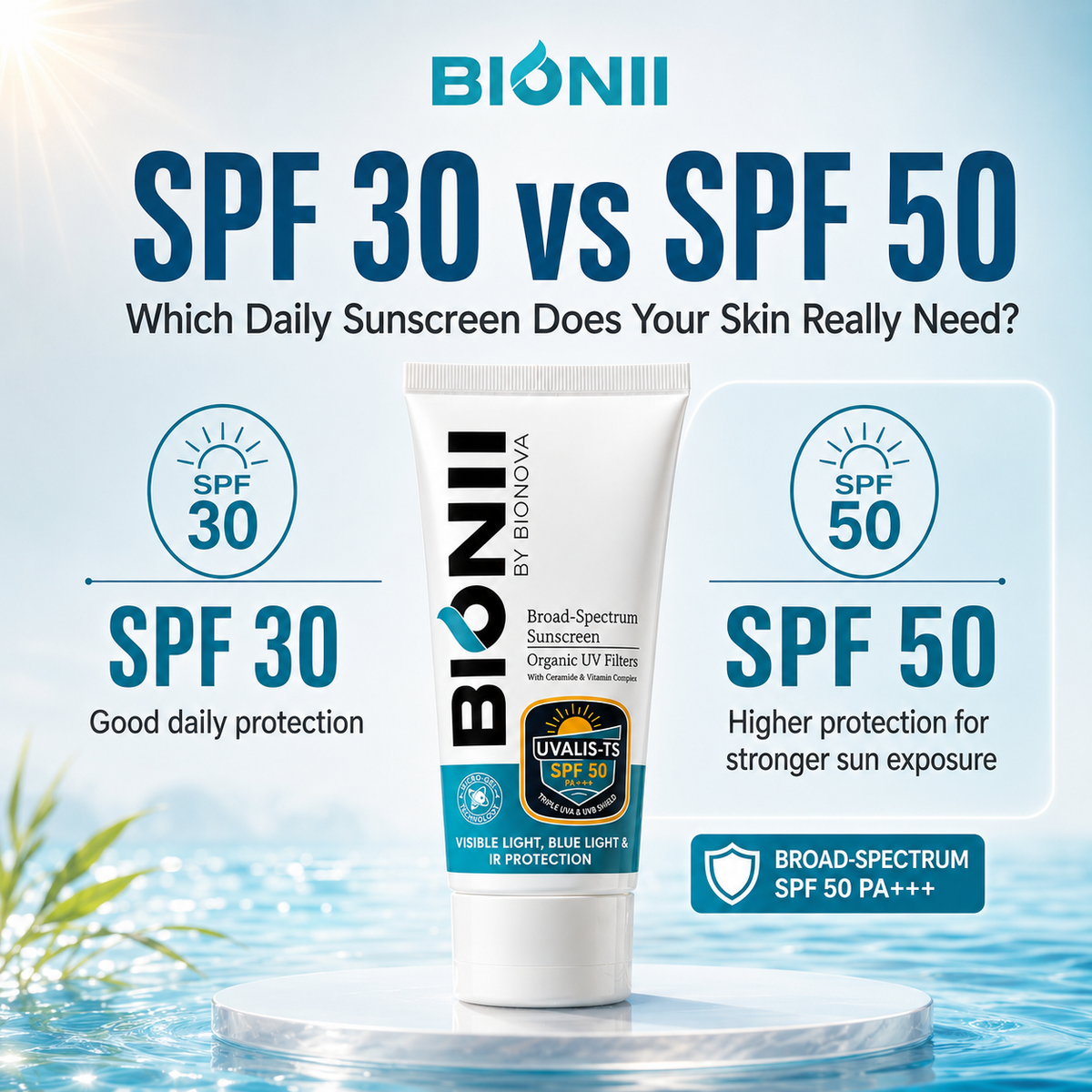
SPF 30 vs SPF 50: Which Daily Sunscreen Does Your Skin Really Need?
Standing in front of the skincare aisle or browsing online, the numbers on sunscreen bottles can easily create confusion. Is SPF 50 nearly twice as protective as SPF 30? Does a higher number mean you can stay out in the sun all day without reapplying?
Choosing the right daily sun protection comes down to understanding how UV radiation interacts with your skin and how different rating systems protect against premature aging, hyperpigmentation, and cellular damage.
What Does SPF Actually Mean?
SPF stands for Sun Protection Factor. It measures protection exclusively against UVB rays—the high-energy wavelengths responsible for sunburn and direct epidermal damage.
The SPF number indicates a relative multiplier of how much solar energy it takes to cause skin redness compared to unprotected skin, assuming standard application (2 mg/cm²).
-
SPF 15 blocks approximately 93% of UVB rays.
-
SPF 30 blocks approximately 96.7% (rounds to ~97%) of UVB rays.
-
SPF 50 blocks approximately 98% of UVB rays.
-
SPF 100 blocks approximately 99% of UVB rays.
SPF 30 vs SPF 50: The Key Differences
The difference between SPF 30 and SPF 50 looks small on paper (97% vs. 98%), but looking at the UV rays that penetrate reveals the real impact:
| Feature | SPF 30 | SPF 50 |
| UVB Radiation Blocked | ~96.7% | ~98.0% |
| UVB Radiation Allowed Through | ~3.3% | ~2.0% |
| Relative Penetration Difference | Allows ~65% more UVB rays to hit skin than SPF 50 | Allows ~39% fewer UVB rays to hit skin than SPF 30 |
| Application Realities | Most people under-apply, lowering effective protection to ~SPF 10–15 | Under-application leaves an effective cushion around ~SPF 20–30 |
| Ideal For | Brief, low-exposure indoor days | Daily active wear, outdoor exposure, photo-sensitive or hyperpigmentation-prone skin |
Because most people apply only a fraction of the recommended amount of sunscreen, SPF 50 provides a crucial safety margin that keeps your actual protection higher throughout the day.
Don’t Forget UVA: Why the PA+++ Rating Matters
Sun protection isn't only about preventing sunburn. UVA rays make up 95% of the UV radiation reaching Earth. They penetrate deep into the dermis, breaking down collagen, triggering dark spots, and driving photo-aging year-round—even through window glass and on cloudy days.
Sunscreen labels address UVA protection through the PA rating system (Protection Grade of UVA):
-
PA+: Light UVA protection
-
PA++: Moderate UVA protection
-
PA+++: High UVA protection (Persistent Pigment Darkening factor of 8 to 16)
-
PA++++: Extremely high UVA protection
A complete daily sunscreen must offer Broad Spectrum coverage, combining a high SPF (UVB defense) with a robust PA rating (UVA defense).
How to Choose the Right Daily Sunscreen for Your Routine
To make sun protection a consistent habit, your formula should meet these benchmarks:
-
Lightweight Texture: Avoid heavy, occlusive creams that clog pores or feel greasy under makeup.
-
Zero White Cast: Look for modern formulations that blend invisibly into all skin tones.
-
Broad-Spectrum Defense: Look for at least SPF 30 to SPF 50 paired with PA+++ ratings.
-
Skin-Supporting Ingredients: Added antioxidants and soothing actives help neutralize free radicals generated by environmental stress.
Featured Pick: UVALIS-TS SPF 50 PA+++ Sunscreen by Bionii
If you are looking for advanced daily defense that wears comfortably on the skin, UVALIS-TS SPF 50 PA+++ Sunscreen by Bionii delivers high-potency protection with an elegant, wearable finish.
Why UVALIS-TS Stands Out:
-
Dual-Action Shield (SPF 50 & PA+++): Delivers over 98% UVB blockage while actively safeguarding the dermal matrix from deep-penetrating UVA rays.
-
Invisible, Non-Greasy Texture: Absorbs quickly without leaving a chalky residue, making it an effortless base under makeup or on bare skin.
-
Photostable Defense: Formulated to resist rapid degradation when exposed to direct daylight, ensuring reliable daily performance.
-
Everyday Skin Compatibility: Designed to protect without triggering excess congestion or heaviness during warm and humid conditions.
How to Apply for Maximum Protection
-
Dose Correctly: Use the two-finger rule (two full strips along your index and middle fingers) for your face, neck, and ears.
-
Apply as the Final Skincare Step: Smooth evenly over your face after your moisturizer and before makeup.
-
Allow 10–15 Minutes: Let the sunscreen settle and form an even protective layer before sun exposure.
-
Reapply When Active: Reapply every 2 hours if you are outdoors, sweating, or toweling off.
Final Takeaway
While SPF 30 provides good baseline protection under laboratory conditions, SPF 50 with PA+++ delivers the extra safety buffer required in real-world application. Integrating a high-performance formula like Bionii’s UVALIS-TS SPF 50 PA+++ into your morning routine guarantees your skin remains shielded against both surface burns and deep premature aging every single day.
Ready to upgrade your daily sun defense? Explore the Bionii UVALIS-TS SPF 50 PA+++ Sunscreen and make reliable broad-spectrum protection part of your daily ritual.


